




Table of Contents
- Nearly two-thirds of Americans rarely or never get news from AI.
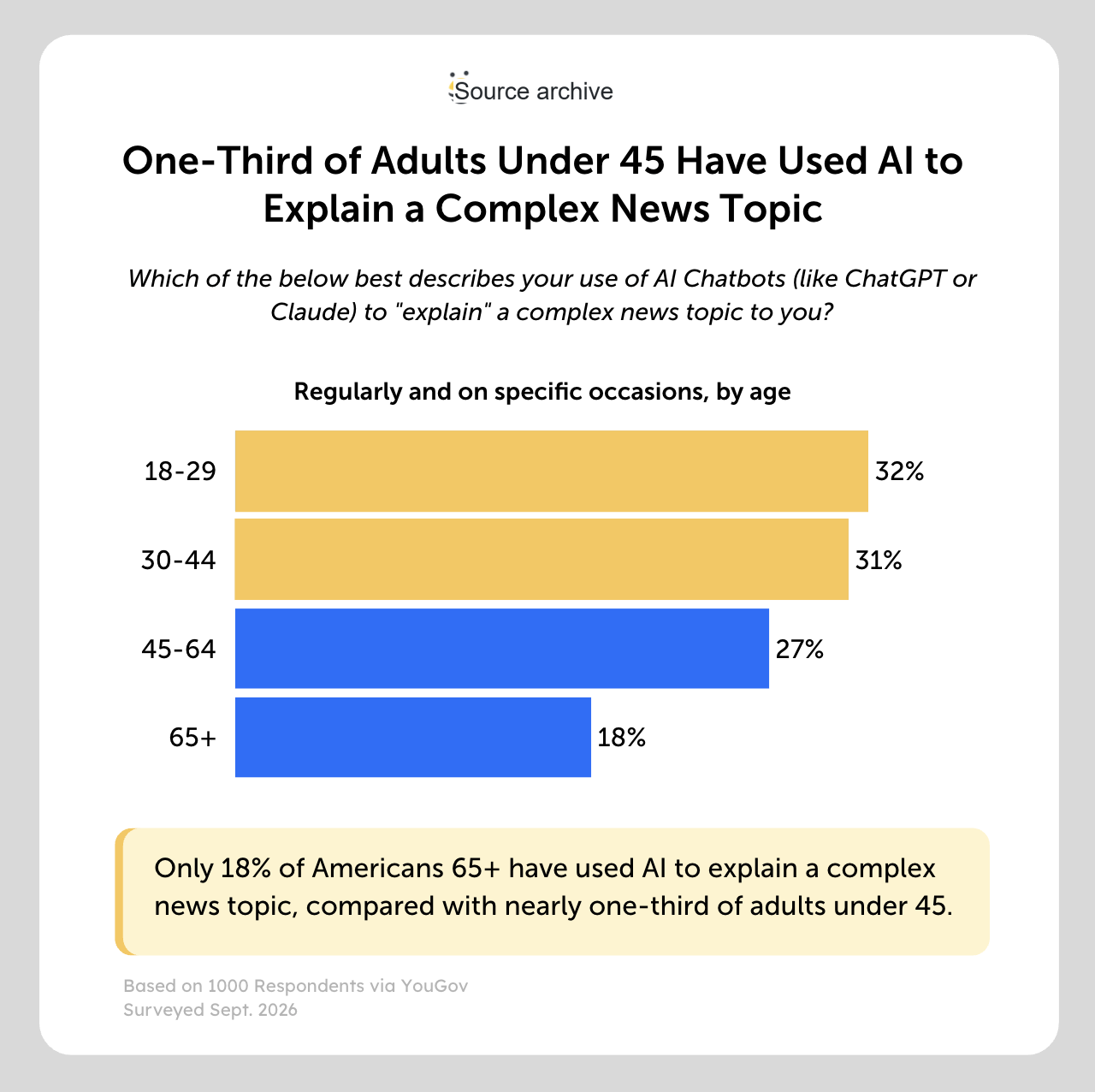
- Roughly one-third of adults under 45 have used AI to explain a complex news topic at least once.
- Just 5% of Americans trust AI news summaries more than traditional news outlets.
- Over two-thirds of AI news users report encountering inaccurate information.
- Three-quarters of AI news users say they click source links at least sometimes.
- Just 10% say they always click, so a citation doesn’t guarantee a visit.
In January 2026, we surveyed 1,000 Americans through YouGov about how they use AI to consume news.
Fast forward eight months, and a lot has happened in the AI world.
Americans are anti-data center, wary of AI firms’ grasp on AI safety, and recently, an ex-Anthropic employee warned AI will destroy the world.
With all this going on, we wanted to check in on how Americans get their news from AI.
(Check out the YouGov podcast I did on this topic.)
Here’s what we found.
How Often Do Americans Get News From AI?
64% of Americans we surveyed say they never or rarely get their news from AI.
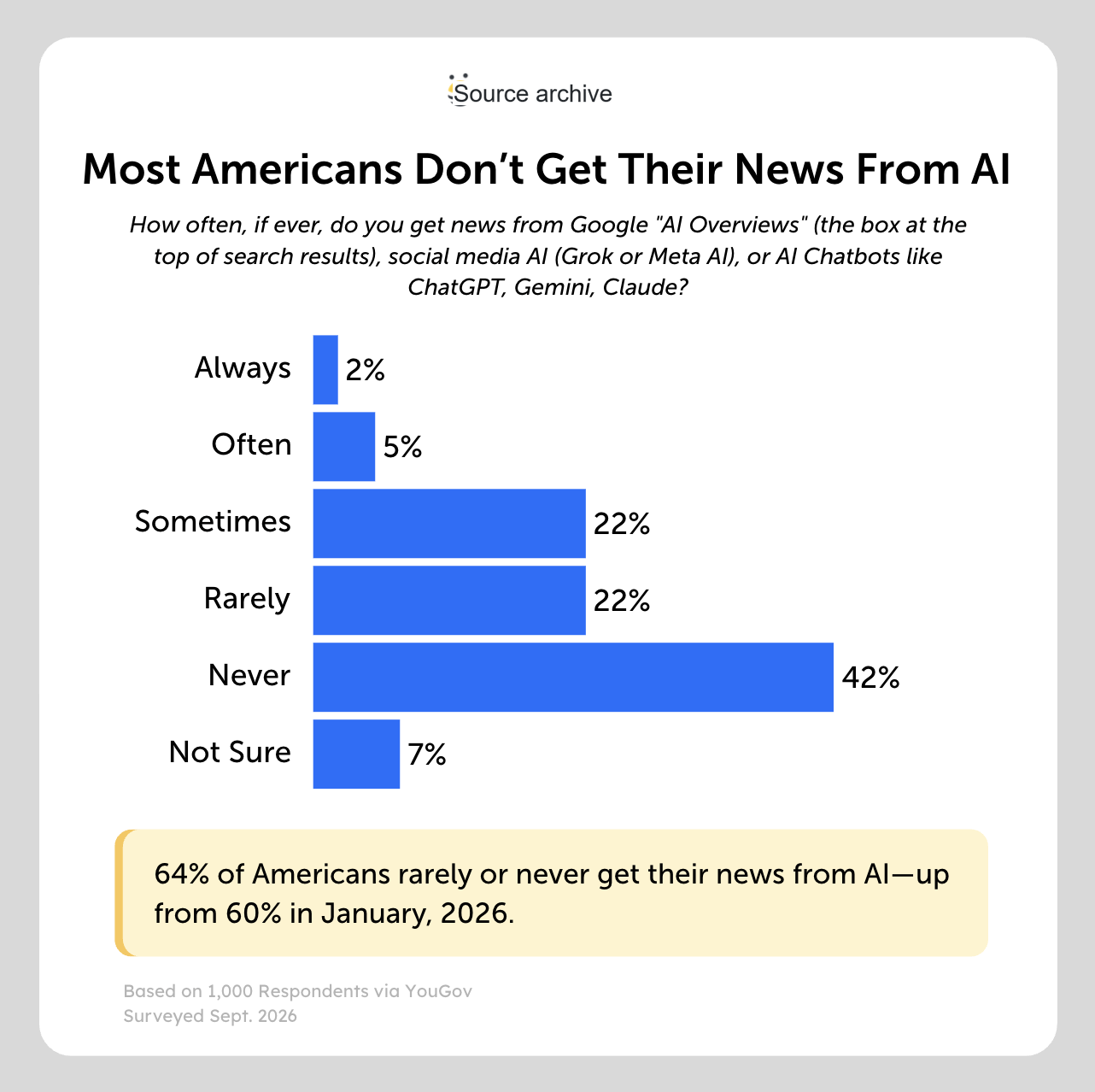
This is up 4 percentage points from our January survey.
For this analysis, I also wanted to dig a bit into age demographics, given how much we know about how younger generations search differently online.
How Often Do Different Age Groups Get Their News from AI?
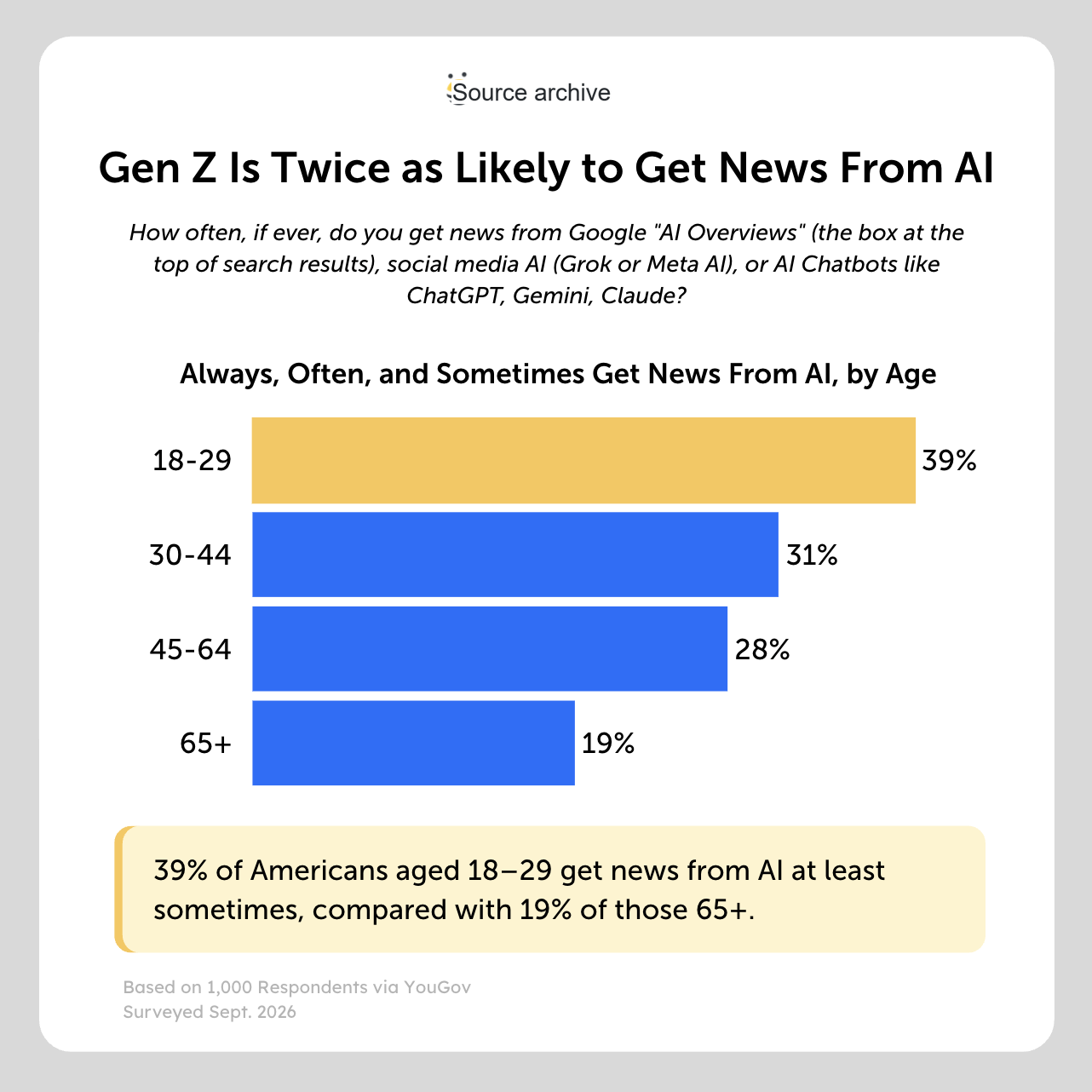
We found that younger age groups, especially 18-29-year-olds, are more likely to get news from AI than older generations.
Tech adoption amongst older professionals in the US is still a hurdle, according to a survey from Yooz.
This could be a reason why the younger generation is more open to getting their news from AI.
But we also asked how Americans use AI in their news consumption—specifically, whether they use it to explain complex news topics.
Let’s look at that next.
How Often Do Americans Use AI to Explain Complex News Stories?
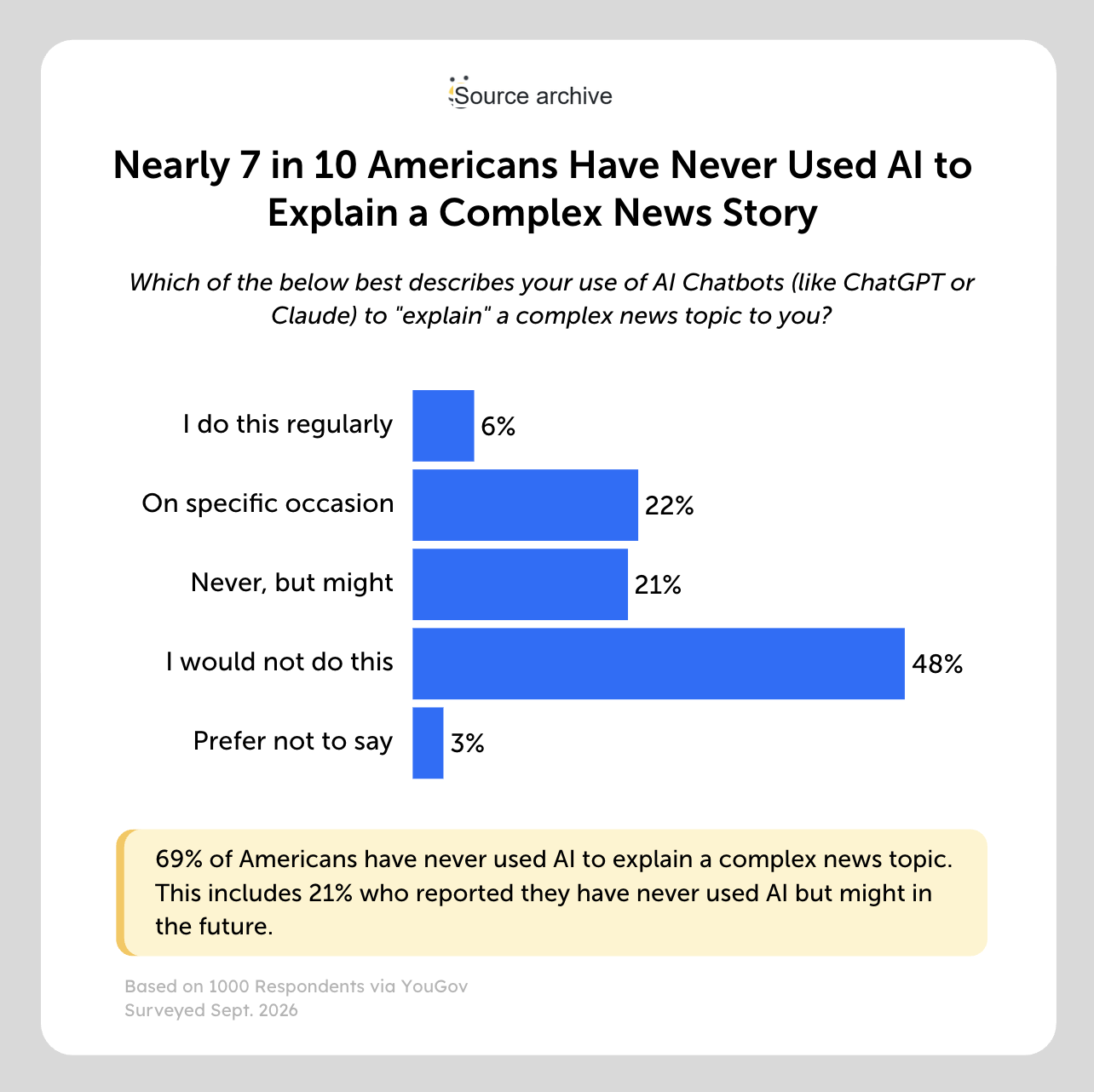
Our research shows that just 6% regularly use AI to explain complex news stories and just 22% do so on specific occasions.
That leaves 69% who have never used AI in this capacity.
Next, let’s see whether the younger generation is more open to using AI to explain complex news topics.
How Often Do Different Age Groups Rely on AI to Explain Complex Topics?
Roughly one-third of adults under the age of 45 have used AI to explain a complex news topic at least once.
As I mentioned before, older generations may simply not trust AI, which is why they aren’t asking it for news updates, much less to explain complex news stories.
So, let’s look at how trust shapes AI interaction.
Do Americans Trust AI for News?
Just 5% of Americans reported trusting AI-generated news summaries more or somewhat more than traditional news outlets.
This is down from 7% in our January survey.
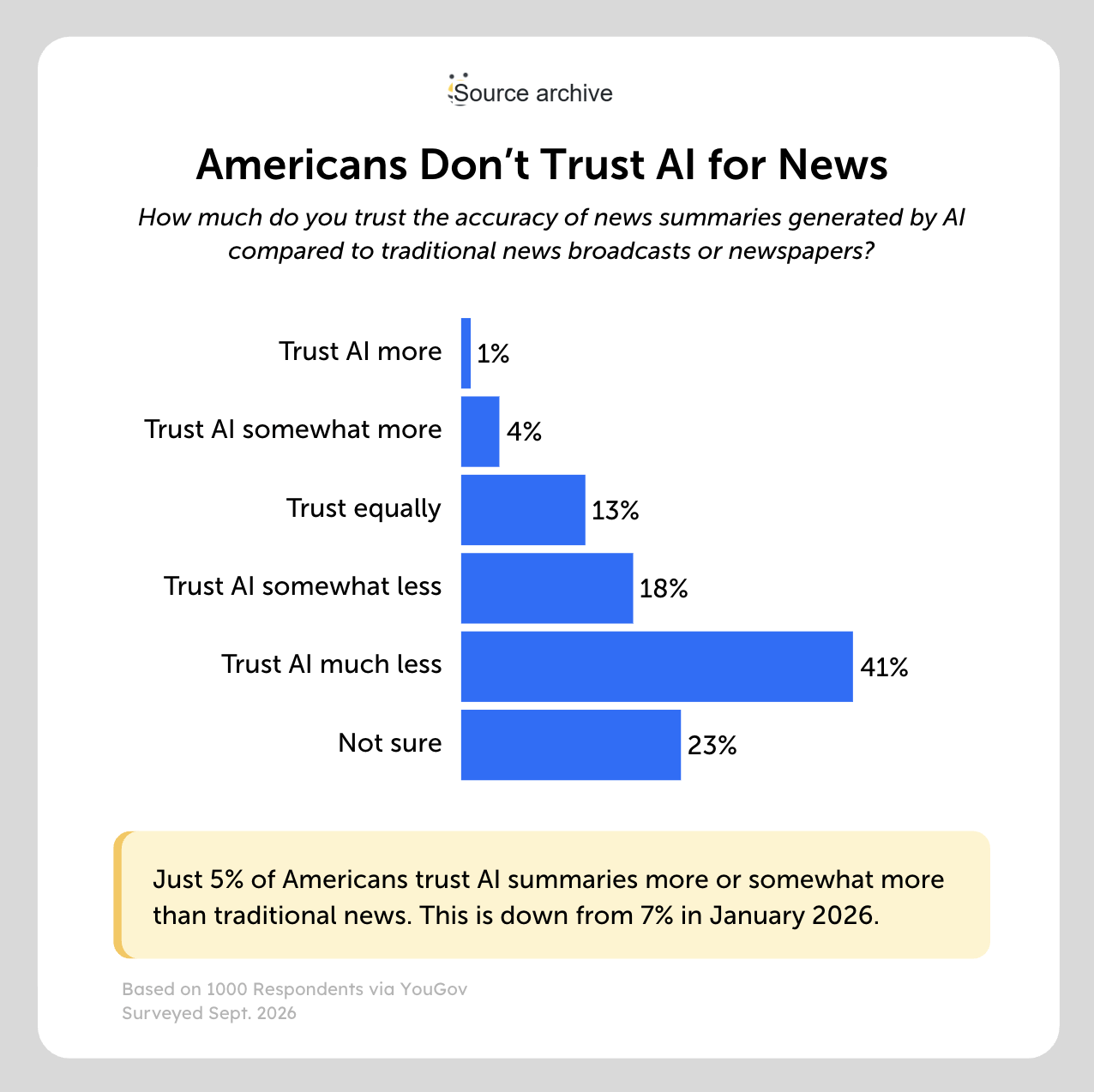
Overall, most people trust traditional media far more for their news.
But let’s see again whether the generational divide still exists.
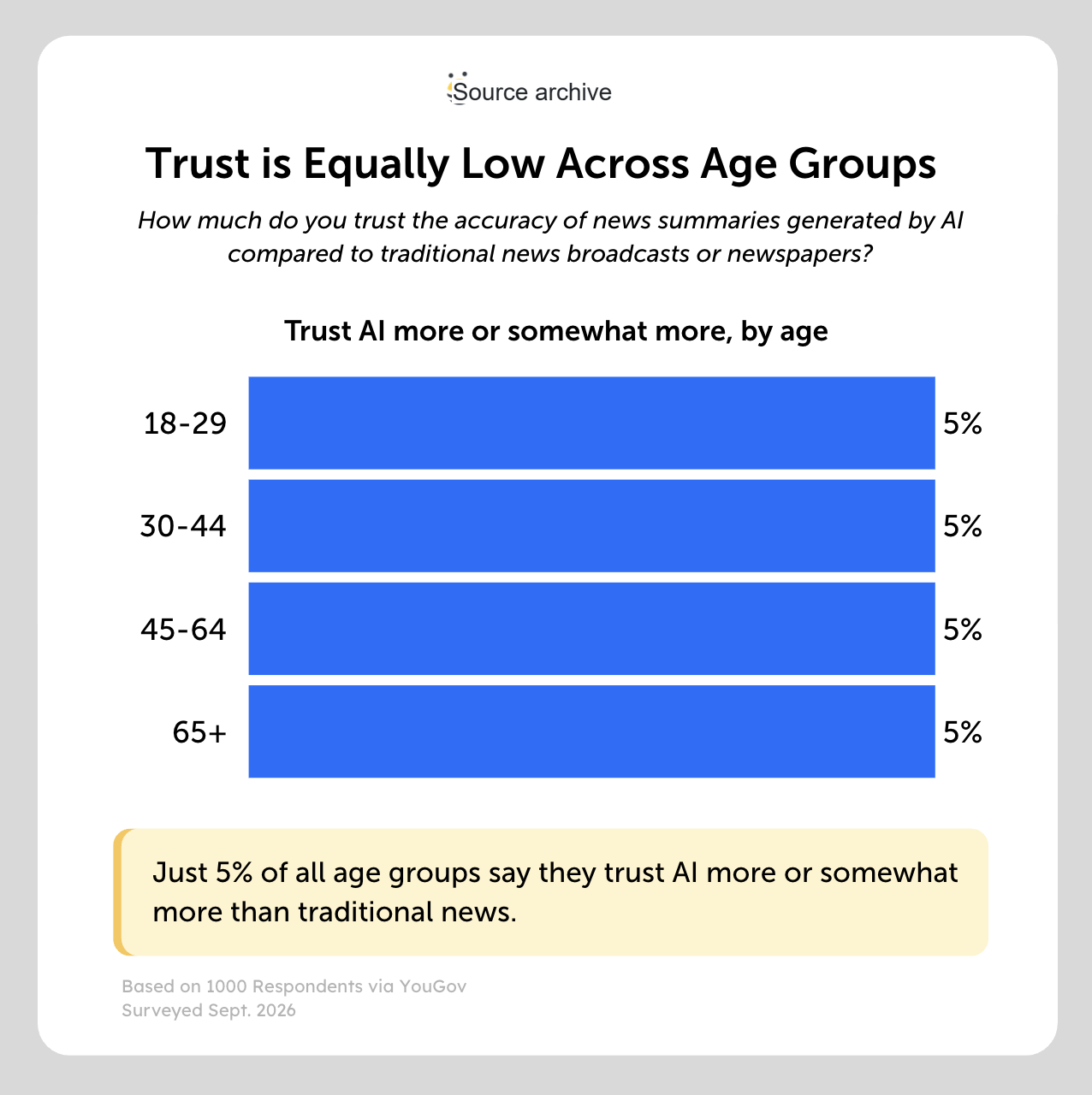
Do Different Age Groups Trust AI More?
For all groups, just 5% trust AI more or somewhat more than traditional media.
When we talk about trust in AI, we typically talk about hallucinated information.
And while studies show that hallucination rates vary drastically from platform to platform, I still wanted to get a sense of how often people were actually seeing them in the news.
How Often Do Americans Spot AI Hallucinating About News Events?
Over two-thirds (68%) of Americans who have used AI report it hallucinating information about a news event at some point (combining always, often, sometimes, and rarely).
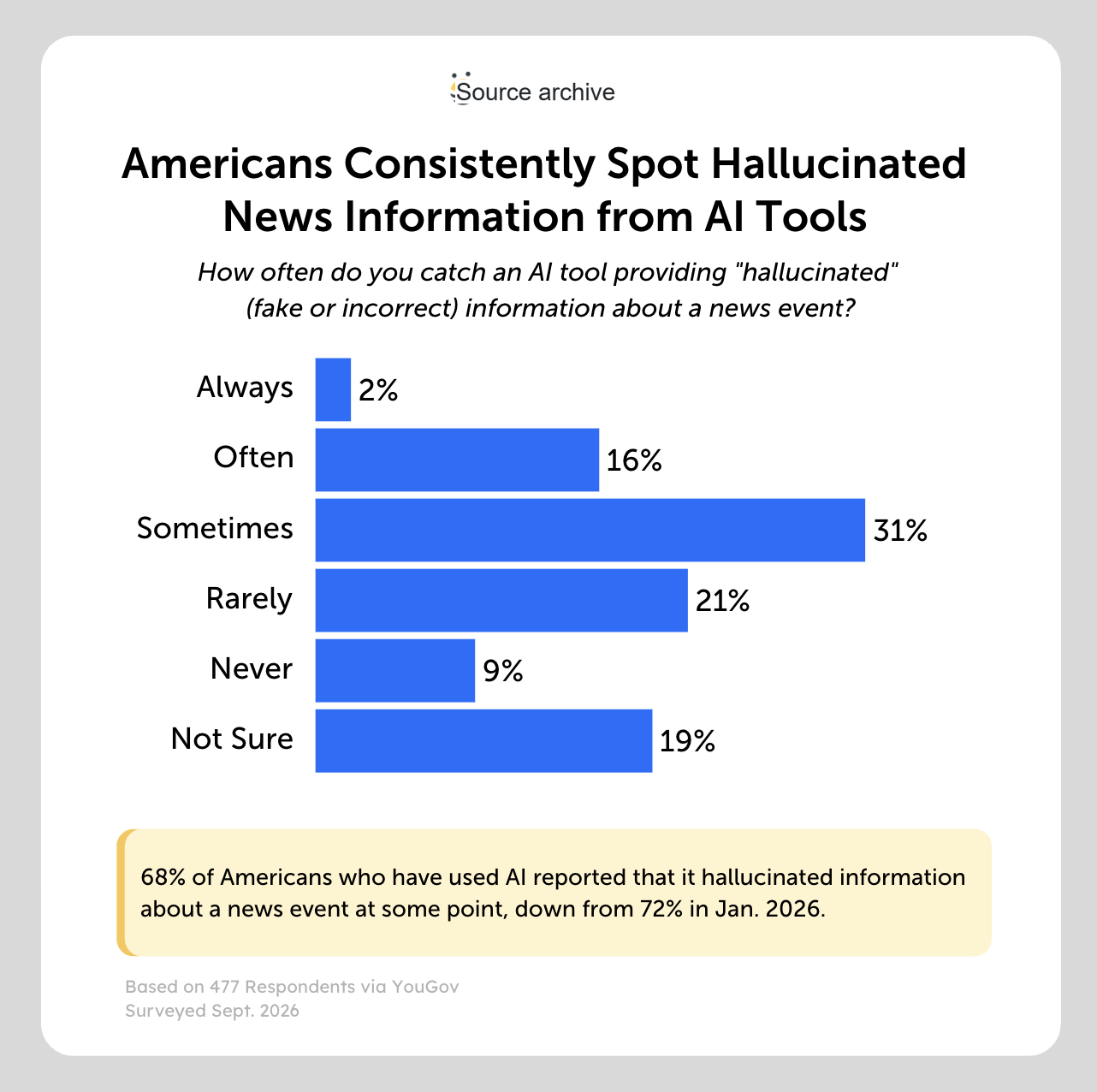
This hallucination rate is actually down about 4 percentage points from our original survey in January.
Note: Because we filtered out respondents who never used AI, our sample sizes were too small to publish the age breakdown for this question.
But it’s one thing to spot hallucinated information, and another to confirm it by checking the links AI provides.
In general, Pew Research has said that just 1% of users in their 500-user study in March clicked on a link when a Google AI Summary presented it.
Let’s see if that changes with our study of news consumption.
How Often Do Americans Click on News Links in AI Summaries?
Just 10% of Americans always click on news links when reading an AI news summary, up from 7% in January.
More broadly, 76% of Americans at least sometimes (including always, often, and sometimes), consistent with January.
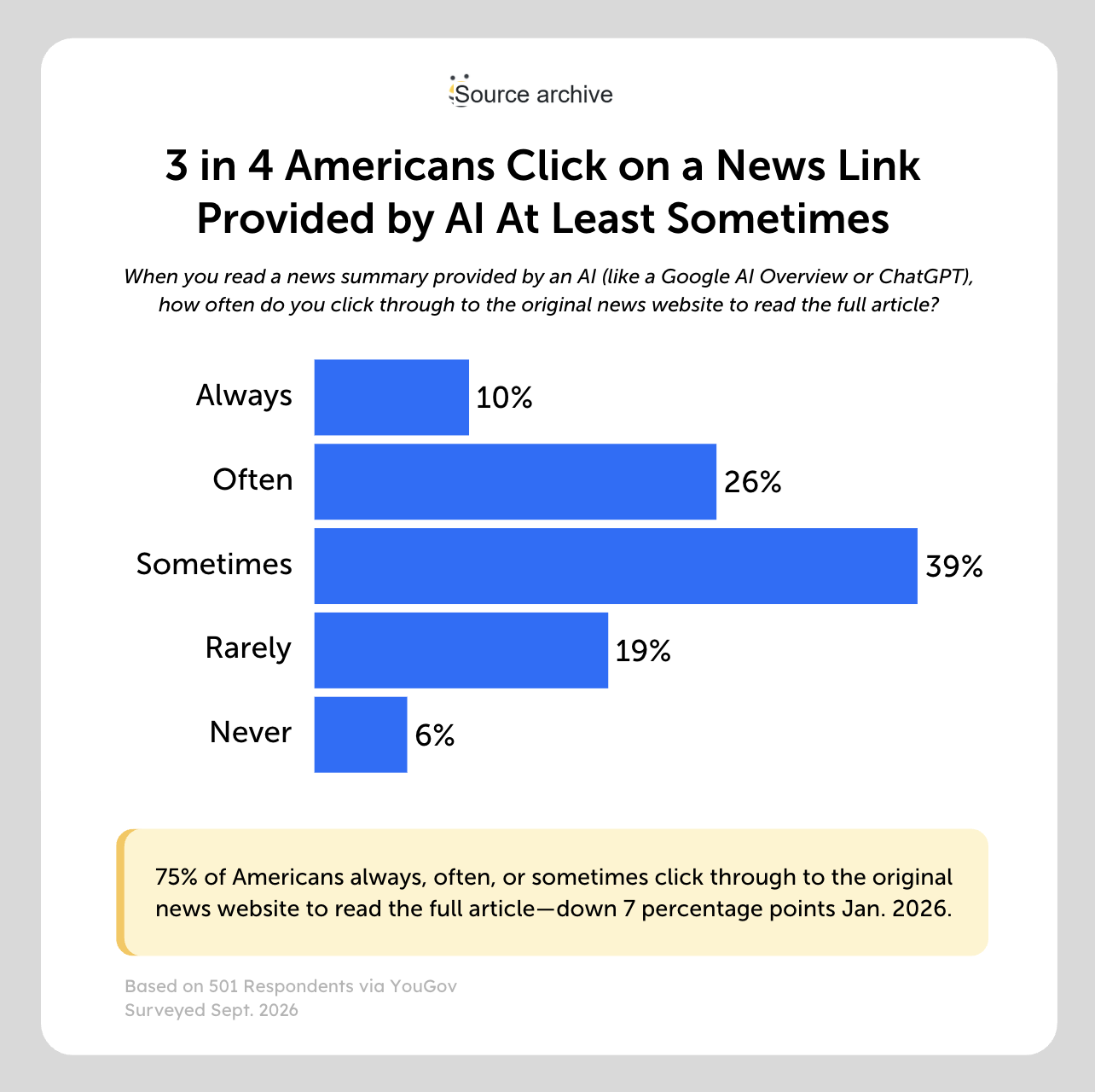
In a perfect world, that “Always” group is 100%.
But despite the fact that virtually no one trusts AI over traditional news sources and people are spotting hallucinations, virtually no one is clicking every time .
I can take some solace in the fact that the “Never” group is just 6%.
Note: Again, the age breakdown had a lower sample size than we wanted to publish, so we’ve left it out of this study.
What Does This Study Mean for News Publishers?
I think this study is great news for traditional news publisher sites like CNN or The New York Times.
While AI may be taking traffic from many sites, it doesn’t appear to be “stealing” users interested in the news, at least not according to this data.
The somewhat uncomfortable truth for publishers who feel AI is poaching traffic is that most of the traffic Google is taking is either informational content or Google SERP features.
This doesn’t mean Google and Google AI Overviews or AI Mode aren’t taking traffic, but the idea that users will get their news from AI still seems a way off—again, according to our usage and trust responses.
Barry Adams said on our podcast, “I won’t deny that AI overviews have accelerated the problem. They do reduce click-through rates for certain types of content.”
But he went on to say that “A lot of publishers now believe Google traffic is going to disappear entirely.
The data doesn’t support that.
What’s actually happened is that publishers have coasted on Google’s overall growth rather than building their own share of voice.
For years, search as a platform kept growing — more queries, more traffic distributed across the web.
That rising tide lifted everyone’s boats. Now that growth has flatlined. Google isn’t shrinking dramatically, but it’s no longer expanding.”
So, while the publishers may be feeling the heat, Americans don’t seem to be moving to getting their news from AI…yet.
What Does This Study Mean for PR?
On the surface, three-quarters of Americans clicking on links at least sometimes feels like a nod towards the importance of getting your brand to appear in citations.
But realistically, the fact that only 10% click links all the time speaks to the broader web concern about dwindling organic traffic caused by zero-click searches.
And it shows you can’t rely on citations for traffic and exposure.
Plus, as our study of over 4 million AI citations has shown, citations can vary greatly based on prompts.
So, to me, getting your brand mentioned in AI answers is still more important than getting citations if you want to drive traffic to your site and increase awareness.
To get your brand mentioned, you need to think beyond the news, too. Think review platforms, forums like Reddit, social platforms like TikTok.
Being the news is also more impactful than being mentioned in passing within a news story.
Good luck out there.
Methodology:
YouGov surveyed 1,000 Americans through its survey platform on Sept 15, 2026. For questions about AI news consumption habits (i.e., clicking links provided by AI and experiences with hallucinations), we omitted responses from respondents who chose “N/A,” indicating they do not consume news through AI.


 Check out the OutreachLark Podcast